YOUR RESULT, EXPLAINED
My radon test came back high. What happens next?
A result at or above 4.0 pCi/L means it is time to take action—not panic.
The short answer
A high radon result is fixable. Here are your next steps:
Check how the test was taken
Make sure the test followed proper closed-building conditions and timing.
Confirm the result if needed
If you're unsure, a follow-up test can help verify the result.
Request a mitigation assessment
A qualified local professional can evaluate your home and recommend a solution.
Based on Missouri DHSS and EPA guidance.
Where does your result fall?

What does 4.0 pCi/L mean?
4.0 pCi/L is the EPA action level for radon—the concentration at which the EPA and Missouri DHSS recommend taking action to reduce radon in your home. It is not a sharp line between safe and unsafe. Rather, it is the level where the health risk is high enough that mitigation is strongly recommended.
There is no truly safe level of radon. The EPA also suggests considering action when results are between 2.0 and 4.0 pCi/L. Lung cancer risk from radon depends on both the concentration and how long you are exposed. The goal of mitigation is to reduce radon below 4.0 pCi/L, and ideally below 2.0 pCi/L.
Missouri DHSS reports that radon is present in every Missouri county, and that one in three homes tested through its residential testing program had results above the recommended action level.
Should I test again?
If your result came from a short-term test (2–7 days), you may want to confirm it with a follow-up test—especially if the result was close to 4.0 pCi/L, or if the test conditions were not ideal (windows open, fans running, or the test was shorter than recommended).
A long-term test (90 days or more) gives a better picture of your year-round average radon level, because radon fluctuates with seasons and weather. If your first result was significantly above 4.0 pCi/L—for example, above 8.0 pCi/L—Missouri DHSS recommends taking action rather than spending time on a second test.
If you are confident the test followed proper closed-building conditions and the result is clearly elevated, you can move forward with requesting a mitigation assessment.
What if this was part of a home sale?
If the test was part of a real-estate transaction, the process is slightly different. Missouri recommends that legal-transaction testing be performed by a professional using a continuous radon monitor, rather than a DIY test kit. The test should be conducted during the inspection period with proper closed-building conditions.
If the result is at or above 4.0 pCi/L, mitigation is commonly negotiated as part of the sale. The buyer and seller can agree on who pays for the system—often handled as a repair credit or a condition of the sale. There is no legal requirement that the seller pay, but it is a common point of negotiation.
Learn more about radon in home salesWhat will a contractor examine?
A qualified radon professional will examine your foundation type, the layout of your home, and the most likely path for radon entry. They will look at:
- Whether you have a basement, crawl space, or slab-on-grade foundation
- The condition of your sump pit, if one is present
- Cracks or openings in the floor slab or foundation walls
- The best location for the suction point and pipe routing
- Whether electrical is available for the fan
- Whether the vent can be routed to exhaust safely above the roofline

A typical radon mitigation system vents radon safely above your home.
How does a mitigation system work?
A radon mitigation system uses sub-slab depressurization to draw radon from beneath the foundation before it can enter your living space. A pipe is installed through the floor slab (or into the sump pit), connected to a specially designed fan, and routed to the exterior where it vents above the roofline.
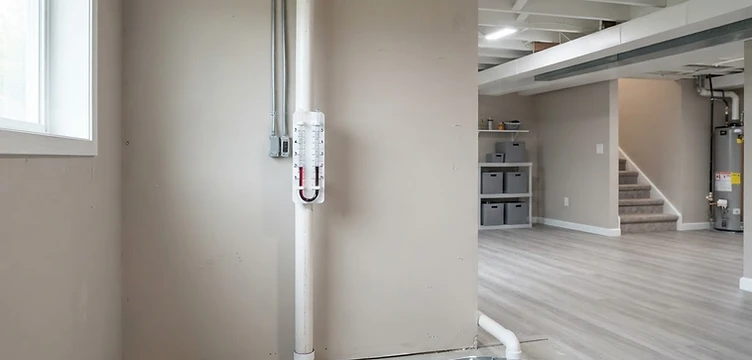
The fan runs continuously, creating a slight vacuum under the floor that pulls radon gas up through the pipe and out of the home. A manometer—a simple U-tube pressure gauge mounted on the pipe—lets you confirm at a glance that the fan is working and the system is pulling a vacuum.
How quickly can mitigation be installed?
Most radon mitigation systems can be installed in a single day, typically taking 4–8 hours depending on the complexity of the home. Homes with crawl spaces, multiple suction points, or difficult pipe routing may take longer.
Scheduling depends on the availability of qualified professionals serving the Columbia area. After installation, a post-mitigation test should be conducted to confirm the system is working.
What should happen after installation?
After your system is installed, a post-mitigation test should be conducted to confirm radon levels have been reduced below the action level. This is typically done 24 hours to 30 days after installation, using a short-term test.
The manometer on the pipe should be checked periodically to confirm the fan is running. Missouri DHSS recommends retesting every two years, or after any major renovation, to ensure the system continues to work effectively.
What credentials should I check?
Missouri recommends checking that your radon professional holds certification from either the National Radon Proficiency Program (NRPP) or the National Radon Safety Board (NRSB). Certification indicates the professional has completed training in radon measurement and mitigation.
Questions to ask before accepting an estimate
- 1Are you NRPP- or NRSB-certified?
- 2What type of system do you recommend for my foundation type?
- 3Where will the pipe and fan be located?
- 4Will the exterior pipe be visible from the street?
- 5Do you include post-mitigation testing in the price?
- 6What warranty do you offer on the system and the fan?
- 7How long will the installation take?
- 8Will you seal cracks and the sump pit as part of the installation?
Need more information?